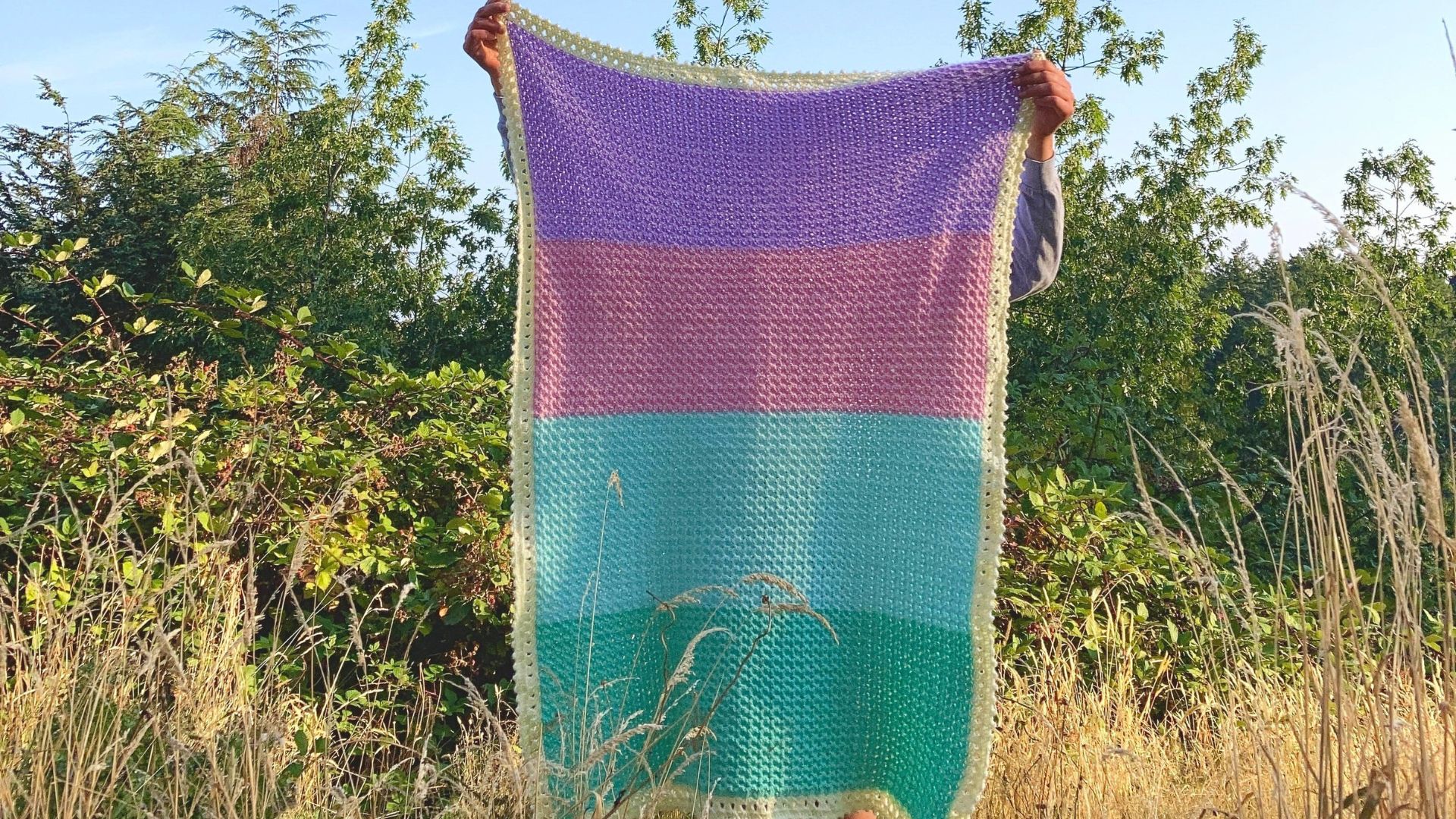
Understanding gauge and stitch multiples is helpful when adjusting and designing crochet blanket patterns. In this post, I am going to discuss gauge, different blanket sizes, stitch multiples, foundation chains, and turning chains!
What is gauge, and how do I measure it?
Gauge tells you how many stitches and rows fit into a specific measurement, most often a 4” x 4” (10 cm x 10 cm) square.
- To measure your gauge, begin by making a small swatch using your chosen yarn and hook.
- Work a small chain that is at least 4” (10 cm) long, ideally 5” (13 cm) for more accuracy.
- Starting at row 1, work the rows in your pattern until your swatch is about 5” (13 cm) tall. For your gauge swatch to be relevant to your project’s pattern, it needs to be worked in the same stitch pattern that the blanket body uses.
- Measure a 4” (10 cm) square. Avoid the side edges and top and bottom rows of the swatch, as measuring your gauge is more accurate in the centre.
- Count the number of stitches across and rows vertically within that square. This gives you your stitch gauge and row gauge. Avoid rounding decimal numbers, as these small differences can add up over time.
- If your gauge matches the pattern (you count the same number of stitches and rows within the 4” (10 cm) square), your finished blanket will match the designer’s measurements.
- If you count more stitches and rows, your tension is tighter, and your finished blanket will be smaller.
- If you count fewer stitches and rows, your tension is looser, and your finished blanket will be larger.
To adjust your gauge, go up a hook size if your tension is tighter and go down a hook size if it is looser. Work another swatch and remeasure to see if this change helps. You may need to adjust your hook again or change your yarn to one that is more similar to what the pattern uses.
For blankets, if you match the stitch gauge but your row count is off, you can adjust the number of rows you work. If the designer worked 87 rows, you may need 92 rows to reach the same height, so adjust this accordingly.
For blankets, exact sizing is usually less important than for garments. However, gauge still matters because it affects how much yarn you will need and the drape of the blanket. A looser gauge uses more yarn, as the stitches are bigger, and creates a softer, more flowy blanket. A tighter gauge will use less yarn, and the blanket will be warmer and denser.
Remember, your gauge and tension are unique to you. They depend on how you hold your yarn, how the loop sits on your hook, and your stitching motion, such as if you pull downwards slightly when working a stitch. Your tension can even vary depending on your mood or the weather. This means that even with the same yarn and hook, your gauge may be different than the pattern you are following. Use your calculations as a guide, but always measure and adjust as you go.
What if I want to use a different yarn than the pattern recommends?
I am in the process of working down my yarn stash, so I am often substituting yarns when following patterns. For blankets, I try to match the weight of yarn and a similar number of metres or yards per gram. This helps ensure similar thickness and that I will have enough yarn to complete the blanket.
My Gauge
Using DK yarn and a 4 mm hook, worked in double crochet (dc, US terms), my gauge is:
- About 16 stitches x 9 rows = 4” x 4” (10 cm x 10 cm)
- One row is about 0.5” (1.5 cm) tall
- For my foundation chain, 22 chains = 4” (10 cm)
This means I have about 1.6 stitches per cm and 2.2 chains per cm.
You can use your gauge to calculate the number of foundation chains to work for a desired blanket size.
- Desired width x chains per cm/inch = starting chain estimate
For example, if I wanted a blanket that is 100 cm wide, 100 cm x 2.2 = 220 chains. If each row is about 1.5 cm tall, 120 cm desired length ÷ 1.5 = about 80 rows. So a 100 cm x 120 cm blanket = 220 starting chains and 80 rows.
It is important to note that this is not exact but can act as an estimate. For example, in my swatch, the first row worked into the foundation chain is about 18 stitches per 4” (10 cm), so I may need to chain more than 220 to get a finished width of 100 cm.
Common Blanket Sizes
| Blanket Type | Inches (W × L) | Centimeters (W × L) |
| Lovey | 12 in × 12 in | 30 cm × 30 cm |
| Baby Blanket | 31.5 in × 39.5 in | 80 cm × 100 cm |
| Toddler / Play | 39.5 in × 47.25 in | 100 cm × 120 cm |
| Crib | 45 in × 60 in | 114 cm × 152 cm |
| Afghan / Throw | 50 in × 65 in | 127 cm × 165 cm |
| Twin | 65 in × 90 in | 165 cm × 229 cm |
| Double / Full | 85 in × 90 in | 216 cm × 229 cm |
| Queen | 90 in × 90–100 in | 229 cm × 229–254 cm |
| King | 108 in × 90–100 in | 274 cm × 229–254 cm |
| California King | 104 in × 108 in | 264 cm × 274 cm |
Starting Chains
Estimated using my gauge of 16 stitches x 9 rows = 4” (10 cm). Use as a starting point, then measure and adjust as needed.
| Blanket Type | Number of Starting Chains |
| Baby | 176 |
| Crib | 251 |
| Afghan / Throw | 279 |
| Twin | 363 |
| Double / Full | 475 |
What are stitch multiples and how do they work?
Stitch multiples tell you how many stitches are needed for a pattern to repeat evenly.
- For example, say your stitch that forms your blanket is called “Gem” and is a dc, then sc in the next stitch, then hdc in the next stitch. The repeat is (dc, sc, hdc). This means it needs a space of 3 stitches.
- Now, say you want a dc on each side of the blanket so the edges are straight. So, +2 = extra chains to make the spaces for these edge stitches. Your foundation chain must be a multiple of 3, plus 2 extra chains (3 + 2).
- If you chain 11 (multiple of 3 is 9, +2), this allows for the Gem stitch (dc, sc, hdc) to repeat 3 times and sets aside 2 stitches on either side for the dc edge.
Note that if a pattern has a multiple of, say, 4 + 4, when the number of extra stitches is the same, it may be written as just 4.
Following the stitch multiple is important, as if you don’t, your pattern won’t line up properly because the special stitch can’t be repeated correctly. As a result, your edges may look uneven.
What about the turning chains?
Turning chains give height to your first stitch in each row, which prevents edges from pulling in and making your edges look uneven.
- Single crochet needs 1 chain
- Half double crochet needs 2 chains
- Double crochet needs 3 chains
Patterns will state if these turning chains count as stitches or not. If your stitch multiple is 3 + 2, it is possible that one of these extra stitches is for height and another is for the edge.
- If you work into the turning chain, it counts as a stitch. This usually allows for a looser edge to make a gap for when working your border.
- If you start in the same stitch, it does not count as a stitch. This usually allows for a straighter edge.
How do I adjust my foundation chain while following the stitch multiples?
- Calculate your estimated starting chain from the gauge
- Round to the nearest number that fits the multiple
- Add any extra chains noted
For example, if I were making a baby blanket with DK yarn:
- Calculated chain from table for a baby-size dc blanket = 176 ch
- Pattern stitch multiple is 3 + 2
- Nearest multiple of 3 = 177
- Add 2, so make 179 chains total
The Foundation Chain
The foundation chain is the very first row of chains and determines your blanket width. If it is too tight, edges may curl but if it is too loose, edges may look wavy. Try to keep even tension while chaining, or use a slightly larger hook just for the foundation chain.
Your foundation chain may include extra chains that are not part of the main stitch repeat. For example, a pattern may say “3 + 2, +1 for the foundation chain”. This extra +1 is needed to establish the height for the first row.
How to Customize the Size of Your Blanket
What I love about making blankets is that they are so easy to customize! Following the stitch multiple, you can turn a baby-sized pattern into a king-sized throw.
- Make it wider – add more chains (following the multiple)
- Make it narrower – reduce chains according to the multiple
- Make it longer – crochet more rows
- Make it shorter – stop earlier
Have fun crocheting your blanket collection and experimenting with different yarns, designs, and sizes!